Forum StoriesBetrayalFiction11 min readPart 1 of 3
The Crossing Guard She Tried to Destroy Saved My Son's Life
A stepmother blamed a beloved crossing guard for nearly hitting her stepson — until the school's bus camera exposed a truth no one saw coming.
By WixForum KitchenPublished
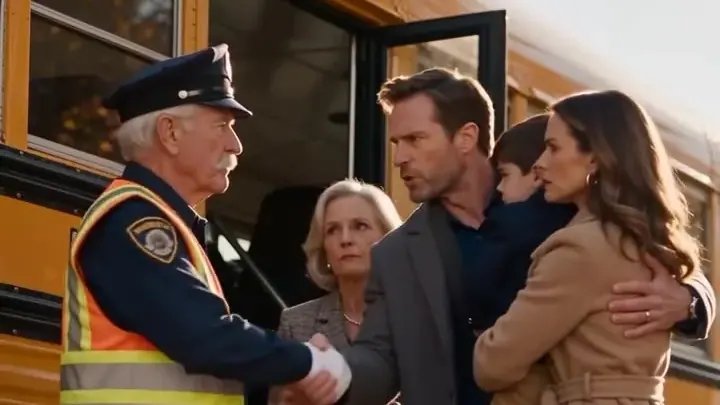
The Man in the Yellow Vest Everyone Called Captain Arthur
My name is Dr. Thomas Vance, and for eleven years I've been a pediatric surgeon at Mercy General in Columbus, Ohio. I stitch together children hurt by other people's carelessness, and I go home grateful that mine are safe. Or I did, until a Tuesday in October taught me that safety is never guaranteed by the people standing closest to your child.
Every morning at 7:50, I drop my son Leo at Brookside Elementary. He's six years old, all knees and questions, and he insists on tying his own red tie even when it hangs crooked. I photograph it every day. I thought I would remember every day of his childhood forever. I was wrong about what I'd actually remember.
At the crosswalk in front of the school stands Arthur Pemberton, sixty-four years old, silver mustache trimmed like a sergeant's, neon-yellow reflective vest over a navy shirt. Before this job, Arthur spent thirty years as a fire captain in the South Side. When the kids found that out, they started calling him Captain Arthur, and he never corrected them.
Twenty-two years on that corner. Not one accident. Not one close call. The parents trusted him the way you trust gravity, and I trusted him more than that — because Leo called him my other grandpa, and Arthur never once let him cross without a handshake.
That Tuesday, my wife Brenda insisted on driving Leo herself. She'd bought a red convertible the week before — a gift to herself, she called it, though I don't recall the occasion. Brenda is twenty-nine, immaculate, and at that point in my life I mistook her polish for warmth. I sat in the passenger seat reviewing patient charts, half-listening to Leo's quiet breathing in the back.
He was quiet. I noticed it and didn't act on it. Children go quiet around Brenda the way dogs go quiet before weather changes. I told myself it was shyness. It was not shyness.
Eight O'Four in the Morning, and the Engine Revved
We pulled up to Brookside at 8:04. The yellow school bus sat at the curb with its red lights flashing, its stop arm swung wide. Arthur stood dead center in the crosswalk, STOP paddle raised, whistle trilling that sharp two-note blast he used every morning for two decades. Leo hopped out, waved at me, and stepped toward the curb.
Then came the rev.
I have spent my life in operating rooms. I know the sound a human body makes when it's about to be broken. What I heard that morning was worse, because it came from a car engine my own wife was driving.
Brenda hit the gas.
What happened next took less than two seconds and rearranged the rest of my life. Arthur moved — not lunged, moved, the way a man moves when his body has rehearsed saving people for thirty years. He crossed the lane, caught Leo by the backpack straps, and pulled him onto the brick curb as the red convertible tore through the space where my son had been standing.
The car ran clean over Arthur's dropped STOP paddle. The bus camera caught every frame. But I didn't know that yet. I only knew that Leo was on the sidewalk, shaking, and Arthur was kneeling beside him with both white-gloved hands on the boy's shoulders.
"You're safe on the sidewalk, young Leo," Arthur said, gravel and warmth at once. "Always stay right behind my vest."
I sprinted to them and gathered Leo so hard against my coat that he squeaked. His heart was hammering through the little navy blazer. He was alive. He was whole. He was unharmed. I told myself the worst part was over.
It had not even started.
Behind me, a car door slammed hard enough to set off a neighboring alarm. Brenda came around the convertible with her sunglasses shoved onto her head, red lipstick drawn into a line I'd never seen before, and she was not looking at her stepson.
She was looking at the old man who had just saved his life.
"Thomas!" she shrieked, in a voice that made two second-graders flinch. "Have this senile old crossing guard fired right now! He wasn't even holding his sign up — he waved Leo right out in front of my bumper while I had the green light!"
I stood there with my son in my arms and could not produce a single word. In twenty years of medicine I have delivered death notices to parents with a steadier voice than I had at that crosswalk.
Arthur rose to his feet with a slow, terrible dignity. He picked up his paddle — cracked, a black tire mark slashing across its reflective face — and held it up like evidence. Because that is exactly what it was.
"Dr. Vance," he said, steady as a flagpole. "I stood in the center of the crosswalk with my whistle blowing and the school bus red lights flashing. Your wife sped straight through the stop zone without looking up."
Brenda scoffed. Actually scoffed, one short bark of contempt, as though a man with a stop sign were a specimen she'd stepped over on the sidewalk. "Nobody's listening to a retired janitor with a paddle, Arthur."
She didn't know he'd commanded a firehouse for a decade. She had never asked him a single question in two years of school pickups. That detail alone should have told me everything about the woman I'd married.
Then Principal Gable came across the courtyard at speed, tweed suit flapping, a black iPad clamped in her hand, and what she said next — and what she turned that screen to show me — ended the argument before it began, and very nearly ended my marriage on that brick curb.
Share this story
Send it to someone who would enjoy it.
Keep reading
More stories

Betrayal
The Nanny Thought the Dog Was Just a Pet — She Never Saw the Camera on His Chest
Pamela pointed at Zeus, claiming he jumped on the bassinet. But Grace knew the truth. And Thomas had the chest-cam footage to prove it—his 95-pound guardian had just saved his baby's life.
8 min readFiction

Betrayal
The Night Nurse Didn't Know the Nanny Camera Was Watching Her Every Move
When my baby's service dog knocked over a medicine bottle, my son screamed 'She switched it!' — and the nanny cam proved we were one dose away from tragedy.
8 min readFiction

Betrayal
The Teapot, the Dog, and the Stepsister Who Tried to Burn My Baby
When Amber pointed at Athena, I knew she was lying. But the vest camera showed the truth—and my rage turned ice cold.
10 min readFiction
Betrayal
The Night Nanny Unplugged the Baby's Monitor — But the Dog's Bodycam Caught Everything
When Rachel's premature baby's breathing alarm went dark, the nanny blamed the dog. But Apollo's K9 bodycam told a different story — and the truth shattered their family forever.
9 min readFiction

Betrayal
The Nanny Thought She Won, but the Dog's Camera Told a Different Story
When a trusted nanny locks a toddler out in the rain, a loyal Bernese Mountain Dog becomes the only witness. Now, a father must choose whom to believe before it's too late.
6 min readFiction

Betrayal
The Nanny Told Police the Dog Attacked Her — Then His Collar Camera Rewound Everything
When the nanny screamed that the family dog attacked her, no one doubted her—until the live collar cam revealed the terrifying truth she tried to bury. Some protectors wear fur.
8 min readFiction