Forum StoriesBetrayalFiction8 min read
He Put His Son on a Hay Bale for Dinner—Then Caleb Read Her Clause Seven
When a Montana rancher's new wife humiliated his eight-year-old son, she never imagined one highlighted clause in their prenup would cost her everything she married for.
By WixForum KitchenPublished
Cold Cornbread on a Hay Bale
My name is Caleb Whitmore, and I've worked Yellowstone Ridge since I was old enough to sit a saddle. The ranch was my father's, and his father's before him, and every fence post out there has a story.
But this story isn't about the land. It's about the night I learned that the woman sleeping under my roof had been starving my son of something no kitchen could cook back into him—kindness.
I'd been a widower for four years when Amber came into my life. Sarah, my late wife, left me with a boy named Wyatt and a silence that filled every room of that big timber-frame house.
Amber filled the silence, all right. Platinum waves, turquoise belts, a laugh that carried clear across the corral. My sister warned me. My foreman warned me. I didn't listen.
She signed the prenup without a flicker of hesitation. "I don't care about your money, Caleb," she told me, tracing the signature line with a manicured nail. "I care about you."
I wanted that to be true so badly that I stopped looking for the truth.
Then came the first Tuesday in October.
The Sound That Made My Blood Run Cold
I'd spent the day at the cattle auction in Billings, shaking hands, closing deals. I came home at dusk expecting the smell of dinner and the sound of Wyatt's boots thundering down the hallway to meet me.
Instead, I heard nothing.
The house was warm and bright, but the dining hall was empty. So was the kitchen. I pushed through the back door into the unheated stone mudroom, and that's where I found him.
My eight-year-old son, sitting on a scratchy hay bale, shivering in his flannel shirt, holding a tin camp plate with nothing on it but a cold crust of cornbread.
And there was Amber in the doorway, a bourbon glass in one hand, pointing her stiletto boot at my child.
"Track one speck of ranch dust onto my new rugs and you'll eat and sleep on that hay bale like a barn dog all week."
Wyatt didn't argue. He didn't cry out. He just looked down at his dusty boots, the boots he'd worn beside me at dawn pushing cattle through the fog, and a single tear cut a clean line through the dust on his cheek.
I have faced blizzards, broken bones, and banks calling in notes. None of it ever hit me like that tear did.
I stepped out of the shadows and took my Stetson off my head.
"Those dusty boots helped me herd cattle at dawn, Amber—and my son owns every acre under your heels."
She spun around so fast the bourbon nearly left her glass. And then the performance began.
"Caleb honey, the auction ended early! I was just teasing him before I brought out his ribeye steak!"
Teasing. That was her word for feeding a child cold cornbread on a hay bale in a freezing mudroom while she sipped liquor a few feet away.
Wyatt grabbed the sleeve of my shearling jacket and held on, his lower lip still quivering. I set my hat on his head, because a boy standing on his own land deserves to feel ten feet tall in that moment.
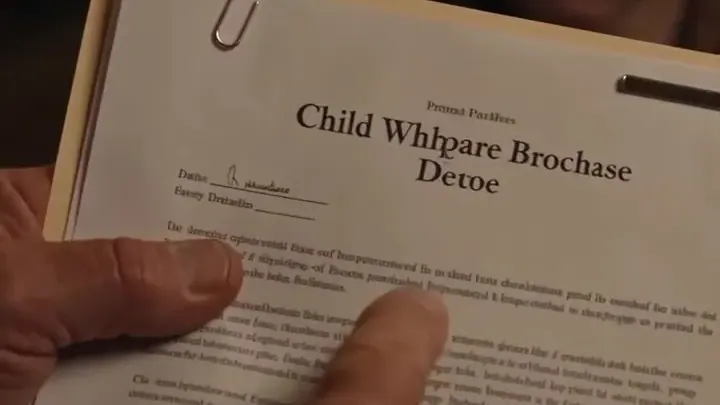
Then I reached into my jacket and pulled out the stamped legal folder Sarah's attorney had prepared before I ever proposed to anyone again.
"Clause Seven of our prenup states that any mistreatment of Wyatt forfeits 100 percent of your ranch shares and spousal payout."
I watched her eyes travel down the highlighted line. I watched the color leave her face like water out of a busted bucket.
Then I tore her share certificate in half and let the pieces fall on the cold stones.
"A ranch truck is waiting outside to take you to the bus station—get off Yellowstone Ridge tonight."
Wyatt walked beside me toward the fire in the dining hall, his hand in mine, both of us silent.
I thought it was over.
It wasn't even close to over.
She Came Back With Lawyers and a Recording
Three days after the bus station, I got the call every rancher dreads—except this one came from my attorney, not the bank.
"Caleb," he said, "Amber's retained counsel. She's filing to contest the prenup."
I put the phone down and looked out at the ridge, where the aspens had gone gold, and felt something I hadn't felt since Sarah died: fear. Not for the land. For Wyatt.
Because Amber wasn't coming for money anymore. She was coming for custody leverage.
She showed up at the county courthouse the following Monday with her sister Dana, a silver-tongued attorney from Bozeman, and a story she'd clearly rehearsed in the truck.
She claimed I had "coerced" her into signing. She claimed she'd been "distressed" on our wedding day. And then she dropped the bomb she'd been saving.
"I recorded our conversation that night in the mudroom," she said, her chin lifted. "Every word. The court will hear how Caleb Whitmore threatened me and threw a penniless woman into the dark."
A recording. She'd been recording from the doorway.
Her lawyer filed a motion the same week to have a child-welfare review opened on me. Within days, a letter reached Wyatt's school in Red Lodge, and a caseworker scheduled a home visit.
Wyatt stopped eating breakfast. He asked me, in a voice too small for an eight-year-old, if Amber was going to take him away from the horses.
"Nobody's taking you anywhere, partner," I told him. "Not while I'm breathing."
But the walls were closing in. The recording, edited right, would make me sound like a bully. The welfare review would drag my boy through interviews. And her attorney was good—smiling, patient, merciless.
My own lawyer didn't say much during those days. He just kept asking me odd questions on the phone.
"Caleb, did Sarah ever talk to you about Clause Seven? I mean really talk—not just sign."
"Did she ever mention a letter? A sealed one?"
I told him I didn't know what he was talking about.
The Envelope Sarah Left Behind
Then he called me into his office and slid a manila envelope across the desk, and my whole world tilted.
"This came from the firm's vault this morning," he said. "Sarah deposited it four years ago, two weeks before she passed. Instructions were clear: it opens only if Clause Seven is ever invoked and legally contested."
My hands shook opening it.
Inside was a letter in Sarah's handwriting, dated March of her last year. And beneath it, a notarized affidavit from our old housekeeper, Ruthie, who had watched Amber's type before.
Sarah's letter began: "If you're reading this, Caleb, then someone treated our boy like he was less than the dirt he loves. I'm sorry I'm not there. But I made sure you're not alone either."
She went on to explain something I never knew: Clause Seven wasn't a standard child-welfare clause she'd pulled out of a template.
She'd written it herself. Word by word. And she'd had it witnessed and recorded—properly, legally, on video—explaining every term to me on our kitchen table the day we signed, with my full, unscripted, unedited consent on camera.
The affidavit from Ruthie documented something else too: Amber's sister Dana had been asking around town about the ranch's value within a month of the wedding.
My attorney leaned back in his chair and smiled for the first time in two weeks.
"Caleb, her recording cuts both ways. It captured your son's tears and her own words—and our video proves your consent was real. She just handed us the strongest case I've seen in twenty years."
But there was one more thing in Sarah's envelope.
A second page I didn't expect. A page that would break Amber's case in open court—and break my heart wide open at the same time.
The Page Amber Never Knew Existed
The second page of Sarah's envelope wasn't legal at all.
It was a copy of Wyatt's adoption papers—drafted, signed, and notarized by Sarah herself, granting me full sole custody the moment she was gone. She'd filed them with the county four years ago. They'd been sitting there, ironclad, ever since.
At the bottom, in her looping hand, she'd written: "Wyatt is not a bargaining chip. He is the whole point. Love him loud, Caleb."
I sat in that office and cried like I hadn't since the funeral.
The hearing came six weeks later, in a courtroom in Red Lodge that smelled like old wood and floor wax.
Amber's attorney played her mudroom recording in full. And that was her mistake—because unedited, it captured everything: her mocking drawl, Wyatt's silence, her own words, "eat and sleep on that hay bale like a barn dog," and my voice answering like a father instead of a bully.
Then our side played Sarah's consent video. Clause Seven, explained term by term, my unguarded agreement, the notary's stamp. The judge asked Amber's counsel one question: "Counselor, if the agreement was coerced, why does your client's own recording show her laughing at the kitchen table that same evening?"
The courtroom went quiet enough to hear the radiator tick.
Her case collapsed in under an hour. The welfare complaint was dismissed with prejudice. The contest was thrown out. And the judge—a rancher's daughter herself, folks said—took off her glasses and looked at Amber for a long moment.
"This court finds Clause Seven fully enforceable. The forfeiture stands. And frankly, ma'am, you should count yourself lucky the remedy here is money and not something you can't appeal."
Love Him Loud
Amber left town that Friday. Dana followed by Sunday. Nobody on the ridge spoke either name again, which in Montana is the coldest sentence there is.
But the real ending happened that night at home, not in court.
Wyatt was sitting at the kitchen table doing homework—or pretending to—when he finally asked the question he'd been carrying for weeks.
"Dad, did Mom know Amber would be mean to me?"
I pulled Sarah's letter from my shirt pocket and read him her last line. "He is the whole point. Love him loud."
Wyatt thought about that for a long moment, the way he thinks about everything, serious as a fence post.
"She's still looking out for me," he said. "From wherever she is."
"Every single day, partner," I told him. "Every single day."
We ate ribeye that night—real ones, off the grill, both of us—and he fell asleep in the big chair by the fire with my Stetson still on his head.
People ask me sometimes if I regret marrying Amber. I tell them no—because that mistake led straight to a letter from my late wife that taught my son the most important lesson this ranch ever produced.
Real family isn't the people who sign their names beside yours. It's the people who protect you when there's nothing in it for them—and in our case, that protection reached clear from beyond the grave, written in a mother's hand, sealed with a clause and a promise.
Love him loud, Sarah said.
So that's exactly what I do—every sunrise, every saddle, every single day on Yellowstone Ridge.
Share this story
Send it to someone who would enjoy it.
From the WixForum kitchen
Cook something tonight
A good story deserves a good meal. Three recipes to try this week:
 Appetizers
Crispy Loaded Potato Skins with Cheddar and Bacon
Total time: 1 hr 45 mins
 Appetizers
Bacon Cream Cheese Stuffed Mushrooms with Garlic Herb Filling
Total time: 55 mins
 Desserts
Crispy Oat Apple Crumble with Pouring Cream
Total time: 1 hr 20 mins
Keep reading
More stories
Betrayal
My Wife Raised Her Hand at My Mother — What She Pulled From Her Bag Changed Everything
Walter came home with daisies and found his wife towering over his mother. A half-burned diary, a toxicology report, and one family secret changed everything.
7 min readFiction
Betrayal
The Pastry Chef Saved the Groom's Son — Then the Video Exposed Everything
A young pastry chef pulled a toddler out of danger at a billionaire's wedding — and uncovered a betrayal no one saw coming.
11 min readFiction
Betrayal
She Blamed the Nanny for the Broken Elevator — Until the Security Footage Told the Truth
A stepmother's lie nearly destroyed an innocent nanny — until one security tablet exposed her in front of everyone.
9 min readFiction