One-Pan Skillet Lasagna with Mozzarella Pull
This one-pan skillet lasagna layers uncooked pasta sheets directly into a rich beef Bolognese, then blankets everything with bubbly mozzarella for an effortless, cheesy dinner.
Published 12 min read
- Total time
- Prep
- Cook
- Rest
- Serves
- 4
- Cuisine
- Italian-American
- Calories
- 580
- per serving, estimated

On this page16 sections
This one-pan skillet lasagna is the ultimate weeknight comfort food. Forget boiling noodles, layering in a casserole dish, and waiting for the oven. Here, uncooked lasagna sheets go straight into a simmering beef Bolognese, soaking up all the rich, herby tomato sauce as they cook. A blanket of shredded mozzarella melts into a golden, bubbly crown, and every spoonful delivers that classic lasagna flavor with a fraction of the effort.
This recipe takes the beloved flavors of lasagna and simplifies them into a single, bubbling skillet. Ground beef is browned with onion and garlic, then simmered in a robust tomato sauce with oregano. Instead of pre-boiling lasagna noodles, the dry sheets are nestled directly into the sauce, where they cook to al dente perfection. A generous layer of whole-milk mozzarella is scattered on top, covered, and melted until gloriously stretchy. The result is a rustic, one-pan meal that delivers all the cheesy, savory satisfaction of traditional lasagna, but with minimal cleanup and maximum flavor.
The appeal
Why you’ll love it
Cooking the lasagna sheets directly in the sauce is the genius of this method. As the pasta simmers in the rich tomato-beef mixture, it absorbs the seasoned liquid, infusing every bite with deep flavor. This not only eliminates the extra pot needed for boiling, but also ensures the pasta is perfectly seasoned from the inside out. The starches released from the pasta also help thicken the sauce, creating a luxurious, clingy texture that coats every strand.
The skillet becomes the vessel for both cooking and serving, which means fewer dishes and a more casual, family-style presentation. Covering the skillet after adding the cheese traps steam, which melts the mozzarella evenly and quickly, producing that iconic, gooey cheese pull. Letting the lasagna rest before serving allows the layers to set slightly, so each slice holds together beautifully when lifted from the pan.
What you need
Ingredients
Makes 4 servings.
Contains:
- Gluten
- Milk
Tools
Equipment
- Large oven-safe skillet (12-inch) with lid
- Wooden spoon or spatula
- Chef's knife
- Cutting board
- Measuring cups and spoons
Swaps
Substitutions
Instead ofGround beef
UseGround turkey or Italian sausage (if using sausage, reduce salt and skip the olive oil).
Instead ofCrushed tomatoes
UseUse 28 oz of tomato puree or passata, or a 28 oz can of whole peeled tomatoes that you crush by hand.
Instead ofDried oregano
UseUse 1 tbsp fresh oregano, or substitute Italian seasoning for a blend of herbs.
Instead ofWhole-milk mozzarella
UsePart-skim mozzarella works, but whole-milk gives a richer, creamier melt.
Good to know
Notes
For the best flavor, use a good-quality crushed tomato or passata. Whole milk mozzarella is key for that creamy, elastic melt—part-skim works, but it won't be as luscious. If you have fresh oregano, use about 1 tablespoon instead of the dried. The amount of salt will depend on your tomatoes and cheese, so taste the sauce before adding the pasta and adjust accordingly.
This recipe is forgiving: you can use ground turkey or Italian sausage in place of beef, and add a pinch of red pepper flakes for heat. If your skillet isn't oven-safe, you can still make this on the stovetop and skip the broiler step. For a vegetarian version, swap the beef for sautéed mushrooms or lentils. The key is to keep the sauce at a gentle simmer so the pasta cooks evenly without burning on the bottom.
Prep
Before you start
Before you start, make sure you have a large oven-safe skillet with a tight-fitting lid. If you don't have a lid, you can use a baking sheet or foil to cover the skillet during the melting stage. Chop the onion and mince the garlic, and measure out the remaining ingredients. If using fresh parsley, chop it and set aside. Have the lasagna sheets ready, and if they are longer than your skillet, break them to fit (you'll need about 5 sheets, or enough to cover the surface in a single layer).
Step by step
Method
Phase 1
Build the Sauce
Step 1: Brown the Beef and Build the Sauce
Heat the olive oil in a large oven-safe skillet over medium-high heat. Add the onion and cook until softened, about 3 minutes. Add the garlic and cook for 30 seconds until fragrant. Add the ground beef and cook, breaking it up with a spoon, until browned and no longer pink, about 5-7 minutes. If there is excess fat, drain it off. Stir in the tomato paste and cook for 1 minute to deepen the flavor. Add the crushed tomatoes, oregano, salt, and pepper.
You’ll need: olive oil · yellow onion, finely chopped · garlic, minced · ground beef · tomato paste · crushed tomatoes · dried oregano · kosher salt · black pepper
Internal temperature 160°F (71°C)
Look for: The sauce should be thick and aromatic, with the beef fully browned and no pink remaining.
Tip: For a deeper flavor, let the tomato paste caramelize slightly before adding the crushed tomatoes.
Step 2: Simmer the Sauce
Let the sauce simmer uncovered over medium-low heat for 5 minutes, stirring occasionally, until it has thickened slightly and the flavors have melded. The sauce should coat the back of a spoon but still be loose enough to cook the pasta.
You’ll need: crushed tomatoes · ground beef
Look for: The sauce will darken in color and the oil may separate slightly on the surface.
Tip: If the sauce looks too thick, add a splash of water or beef broth to loosen it.
Step 3: Season and Adjust
Taste the sauce and adjust the seasoning with more salt and pepper if needed. Keep the sauce at a gentle simmer while you prepare the pasta sheets.
You’ll need: kosher salt · black pepper
Look for: The sauce should be well-seasoned and savory.
Tip: Remember that the mozzarella will add saltiness, so don't over-salt the sauce.
Checkpoint
At the end of this phase, you'll have a rich, aromatic meat sauce with the beef fully browned and the tomato paste deepened in color. The sauce should be bubbling gently and smell wonderfully savory. Taste it and adjust the seasoning—it should be well-balanced and slightly thick, but still liquid enough to cook the pasta.
Phase 2
Cook the Pasta
Step 4: Add the Lasagna Sheets
Carefully slide the uncooked lasagna sheets into the simmering sauce, one at a time, making sure they are fully submerged in the liquid. Use a spatula to gently press them down and ensure they are covered by the sauce. If the sheets stick up, spoon some sauce over them. Let them cook in the sauce for about 3-4 minutes, until they begin to soften.
You’ll need: uncooked dry lasagna pasta sheets
Look for: The pasta sheets will start to soften and curl slightly at the edges as they absorb the sauce.
Tip: If the sheets are too long for the skillet, break them to fit, but try to keep them in one layer.
Step 5: Press Pasta Under Liquid
Continue pressing the lasagna sheets down with the spatula, ensuring they are fully submerged in the simmering sauce. This helps them cook evenly and prevents them from curling or drying out. Let them simmer for another 3-4 minutes, until they are al dente.
You’ll need: uncooked dry lasagna pasta sheets
Look for: The pasta will become pliable and slightly translucent at the edges.
Tip: If the sauce has reduced too much, add a few tablespoons of water to keep the pasta from sticking.
Step 6: Check Pasta Tenderness
Use a fork to test a piece of pasta for doneness. It should be tender but still have a slight bite. If the pasta is still too firm, add a bit more liquid and continue simmering for another 2-3 minutes.
You’ll need: uncooked dry lasagna pasta sheets
Look for: The pasta should be cooked through but not mushy.
Tip: Remember that the pasta will continue to cook slightly when you add the cheese and cover the skillet.
Checkpoint
The lasagna sheets should be softened and pliable, having absorbed much of the sauce. They will look slightly curled and translucent at the edges. When you press a fork into a sheet, it should be tender but still offer some resistance. The sauce should have thickened to a clingy consistency, coating the pasta.
Phase 3
Melt the Cheese
Step 7: Top with Mozzarella and Parsley
Evenly scatter the shredded mozzarella over the top of the lasagna, covering the entire surface. Sprinkle the chopped parsley over the cheese. The cheese should completely cover the pasta and sauce.
You’ll need: shredded whole-milk mozzarella cheese · fresh parsley, chopped
Look for: The cheese will start to melt immediately from the heat of the sauce.
Tip: Use whole-milk mozzarella for the best melt and flavor.
Step 8: Cover and Melt
Cover the skillet with a lid and let the cheese melt over medium-low heat for about 3 minutes, until it is fully melted and bubbly. The steam will help the cheese melt evenly and create a gooey, stringy texture.
You’ll need: shredded whole-milk mozzarella cheese
Look for: The cheese will be completely melted, with small bubbles forming on the surface.
Tip: Don't lift the lid too often, as the steam helps the cheese melt.
Step 9: Broil for a Golden Top (Optional)
If you prefer a browned, golden top, transfer the skillet to a preheated broiler for 1-2 minutes, watching closely, until the cheese is bubbling and spotty brown. This step is optional but adds a nice color and flavor.
You’ll need: shredded whole-milk mozzarella cheese
Look for: The cheese will be golden brown in spots and bubbling.
Tip: Keep a close eye on it under the broiler to avoid burning.
Step 10: Rest and Serve
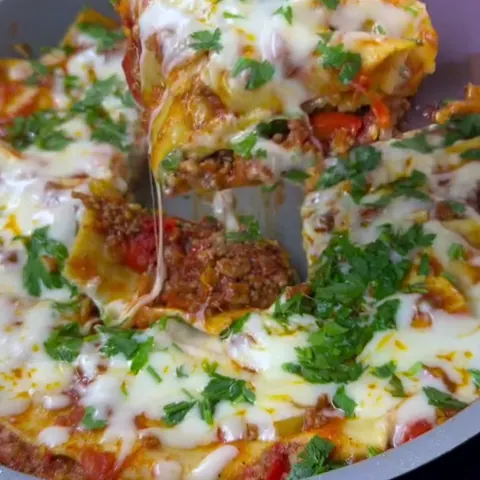
Remove the skillet from the heat and let it rest for 5 minutes. This allows the lasagna to set slightly, making it easier to slice and serve. Use a spatula to lift out a cheesy slice, making sure to get the gooey cheese pull.
You’ll need: ground beef · uncooked dry lasagna pasta sheets · shredded whole-milk mozzarella cheese · fresh parsley, chopped
Look for: The lasagna will hold its shape when sliced, with cheese stretching as you lift.
Tip: Resting is key to clean slices—don't skip it.
Checkpoint
The mozzarella should be completely melted, with a glossy, bubbly surface. If you broiled it, there will be golden-brown spots. The cheese will stretch when you lift a spoonful. The whole skillet should be fragrant with melted cheese and parsley. Let it rest briefly before serving.
Doneness
How to tell it’s done
The lasagna is done when the pasta is tender and the cheese is fully melted and bubbly. To test the pasta, use a fork to pierce a sheet—it should slide in easily but still have a slight bite. The sauce should be thick and clinging to the pasta, not watery. The internal temperature of the ground beef should reach 160°F (71°C) for safety. If you broil the top, the cheese will have golden-brown spots. Let it rest for 5 minutes before serving to allow the layers to set.
Avoid these
Common mistakes
One common mistake is not pressing the lasagna sheets firmly under the sauce, which can cause them to curl and become hard. Make sure each sheet is fully submerged and press down occasionally as they cook. Another pitfall is overcooking the pasta—since it continues to cook when you add the cheese, aim for al dente. Also, be careful not to let the sauce reduce too much before adding the pasta, or it may stick to the bottom. If the sauce looks too thick, add a splash of water or broth.
Cook safely
Food safety
Safe internal temperatures
Cook to at least these temperatures, measured with an instant-read thermometer in the thickest part.
| Food | Minimum internal temperature |
|---|---|
| Ground meat | 160°F (71°C) |
Better results
Tips
Tip 1
For the ultimate cheese pull, use a high-quality whole-milk mozzarella that you shred yourself—pre-shredded varieties often contain anti-caking agents that can inhibit melting. If you want extra flavor, add a sprinkle of grated Parmesan along with the mozzarella. Also, don't be shy with the parsley; it adds a fresh, bright contrast to the rich sauce. When pressing the pasta under the liquid, use a spatula to gently push down, ensuring even cooking.
Tip 2
If you have leftover sauce, you can freeze it for up to 3 months. To reheat, simply warm it in a skillet with a splash of water. This recipe is also great for meal prep: cook the sauce ahead, then add the pasta and cheese when you're ready to eat. If you're cooking for two, halve the recipe and use a smaller skillet. For a crispier top, broil for an extra minute, but watch it closely to avoid burning.
Make it yours
Variations
Spicy Sausage Skillet Lasagna
Swap the ground beef for 1 1/4 lb of spicy Italian sausage (casings removed). Brown it in the skillet without the olive oil, breaking it up. Add 1/2 tsp red pepper flakes with the garlic for extra heat. Proceed with the recipe as written.
Vegetarian Mushroom Skillet Lasagna
Replace the beef with 12 oz of cremini mushrooms, sliced. Sauté them in the olive oil until golden and their liquid has evaporated. Add the onion and garlic, then proceed. The mushrooms add an earthy, meaty texture that pairs well with the tomato sauce.
Creamy White Skillet Lasagna
Skip the tomato sauce and beef. Instead, sauté onions and garlic in olive oil, then add 2 cups of heavy cream, 1 cup of chicken or vegetable broth, and 1 tsp of dried thyme. Simmer, add the pasta, and cook until tender. Top with mozzarella and 1/2 cup of grated Parmesan, then cover and melt.
Gluten-Free Skillet Lasagna
Use gluten-free lasagna sheets (oven-ready or no-boil). Cook them in the sauce as directed, but check for doneness a minute earlier, as gluten-free pasta can become mushy. Ensure all other ingredients are certified gluten-free, including the crushed tomatoes and spices.
On the table
Serving suggestions
Serve this skillet lasagna straight from the pan, family-style, with a big green salad and some crusty bread to soak up the extra sauce. It's a hearty, satisfying meal that needs little else. For a more elegant presentation, use a wide spatula to lift out individual portions, making sure to capture the gooey cheese pull. Garnish with extra fresh parsley and a sprinkle of red pepper flakes if you like a little heat.
This dish pairs beautifully with a simple arugula salad dressed with lemon and olive oil, which cuts through the richness of the cheese and meat. A glass of Chianti or Sangiovese would be a classic match. For a casual weeknight, you can also serve it with garlic bread or roasted vegetables. The leftovers are just as delicious the next day—try them for lunch with a drizzle of olive oil.
Leftovers
Storage & make-ahead
- Fridge
- Store in an airtight container for up to 4 days. Reheat in the microwave or on the stovetop, adding a splash of water if needed.
- Freezer
- Freeze the fully cooked lasagna in a freezer-safe container for up to 3 months. Thaw overnight in the fridge before reheating.
- Reheat
- Reheat in a 350°F (175°C) oven for 15-20 minutes, or in the microwave in 1-minute intervals until hot.
Store leftover skillet lasagna in an airtight container in the refrigerator for up to 4 days. The pasta will continue to absorb sauce, so it may be a bit drier when reheated—add a splash of water or extra tomato sauce to refresh it. Reheat individual portions in the microwave or in a skillet over medium-low heat until warmed through.
Make ahead
You can prepare the meat sauce up to 2 days ahead and refrigerate it separately. When ready to cook, reheat the sauce in the skillet, then proceed with adding the pasta and cheese. Alternatively, assemble the entire dish (without the cheese) and refrigerate, then add the cheese and finish cooking when ready to serve.
Questions
Frequently asked questions
Can this recipe be made without an oven-safe skillet?
Yes, you can make it entirely on the stovetop. Use a regular large skillet with a lid. After adding the cheese, cover and cook over low heat until melted. If you want a golden top, you can transfer the lasagna to a baking dish and broil it, but it's not necessary.
Why are the lasagna sheets cooked directly in the sauce?
This method saves time and adds flavor. As the pasta simmers in the sauce, it absorbs the seasoned liquid, which infuses the noodles with the taste of the beef, tomatoes, and herbs. It also eliminates the need to boil pasta separately, making this a true one-pan dish.
Can the lasagna be frozen before baking?
Yes, you can assemble the entire dish (without the cheese) and freeze it. When ready to cook, thaw overnight in the refrigerator, then reheat in a skillet over medium heat, adding a little water if needed. Add the cheese and cover until melted.
What is the best way to reheat leftover skillet lasagna?
Reheat individual portions in the microwave for 1-2 minutes, or in a small skillet over medium-low heat with a splash of water to keep it moist. For a crispier top, reheat in a 350°F (175°C) oven for 10-15 minutes.
Can this recipe be made with ground turkey or chicken?
Absolutely. Use ground turkey or chicken in place of the beef. Since these are leaner, you may need to add a tablespoon of olive oil to the skillet to prevent sticking. Cook until no longer pink and reach an internal temperature of 165°F (74°C).
Everything in one place: the recipe card below gathers the ingredients, steps and estimated nutrition, ready to print.
Recipe card
One-Pan Skillet Lasagna with Mozzarella Pull
This one-pan skillet lasagna layers uncooked pasta sheets directly into a rich beef Bolognese, then blankets everything with bubbly mozzarella for an effortless, cheesy dinner.
- Prep
- Cook
- Rest
- Total
- Servings
- 4 servings
Ingredients
- 2 tbsp olive oil
- 1 medium yellow onion, finely chopped
- 3 cloves garlic, minced
- 1 1/4 lb ground beef
- 2 tbsp tomato paste
- 1 can (28 oz) crushed tomatoes
- 1 tsp dried oregano
- 1 tsp kosher salt
- 1/2 tsp black pepper
- 5 uncooked dry lasagna pasta sheets
- 1 1/2 cups shredded whole-milk mozzarella cheese
- 1/4 cup fresh parsley, chopped
Instructions
Brown the Beef and Build the Sauce. Heat the olive oil in a large oven-safe skillet over medium-high heat. Add the onion and cook until softened, about 3 minutes. Add the garlic and cook for 30 seconds until fragrant. Add the ground beef and cook, breaking it up with a spoon, until browned and no longer pink, about 5-7 minutes. If there is excess fat, drain it off. Stir in the tomato paste and cook for 1 minute to deepen the flavor. Add the crushed tomatoes, oregano, salt, and pepper.
Simmer the Sauce. Let the sauce simmer uncovered over medium-low heat for 5 minutes, stirring occasionally, until it has thickened slightly and the flavors have melded. The sauce should coat the back of a spoon but still be loose enough to cook the pasta.
Season and Adjust. Taste the sauce and adjust the seasoning with more salt and pepper if needed. Keep the sauce at a gentle simmer while you prepare the pasta sheets.
Add the Lasagna Sheets. Carefully slide the uncooked lasagna sheets into the simmering sauce, one at a time, making sure they are fully submerged in the liquid. Use a spatula to gently press them down and ensure they are covered by the sauce. If the sheets stick up, spoon some sauce over them. Let them cook in the sauce for about 3-4 minutes, until they begin to soften.
Press Pasta Under Liquid. Continue pressing the lasagna sheets down with the spatula, ensuring they are fully submerged in the simmering sauce. This helps them cook evenly and prevents them from curling or drying out. Let them simmer for another 3-4 minutes, until they are al dente.
Check Pasta Tenderness. Use a fork to test a piece of pasta for doneness. It should be tender but still have a slight bite. If the pasta is still too firm, add a bit more liquid and continue simmering for another 2-3 minutes.
Top with Mozzarella and Parsley. Evenly scatter the shredded mozzarella over the top of the lasagna, covering the entire surface. Sprinkle the chopped parsley over the cheese. The cheese should completely cover the pasta and sauce.
Cover and Melt. Cover the skillet with a lid and let the cheese melt over medium-low heat for about 3 minutes, until it is fully melted and bubbly. The steam will help the cheese melt evenly and create a gooey, stringy texture.
Broil for a Golden Top (Optional). If you prefer a browned, golden top, transfer the skillet to a preheated broiler for 1-2 minutes, watching closely, until the cheese is bubbling and spotty brown. This step is optional but adds a nice color and flavor.
Rest and Serve. Remove the skillet from the heat and let it rest for 5 minutes. This allows the lasagna to set slightly, making it easier to slice and serve. Use a spatula to lift out a cheesy slice, making sure to get the gooey cheese pull.
Allergens: Gluten, Milk
Nutrition (estimated, per serving)
- Calories
- 580 kcal
- Protein
- 35 g
- Carbs
- 45 g
- Fat
- 28 g
Estimates only: values vary with brands, substitutions and portion sizes.
Recipe by WixForum Kitchen · wixforum.com
Share this recipe
Send it to someone who’d love it, or save it for later.
Spotted a mistake in this recipe? Let us know.
Keep cooking


