Forum StoriesSecond ChancesFiction15 min readPart 2 of 3
The Billionaire's Secret: How A Mysterious Janitor Saved The World From Astrophysics Disaster — Part 2 of 3
By WixForum KitchenPublished
Echoes of Apollo
The green lights on the console pulsed, a steady, reassuring rhythm against the storm’s continued assault. The probe was safe. The ten billion dollars, the years of tireless work, the hopes of a world watching from afar – all salvaged. But the relief was tainted, overshadowed by the profound mystery of Ruth. Who was this woman who moved between the worlds of custodial duties and the highest echelons of space science with such effortless grace?
As she retreated into the shadows, her faint smile lingered in my mind. It wasn't a smile of triumph, but of quiet satisfaction, the kind earned by a job well done, a problem solved. It was the smile of someone who understood the stakes, not just of this mission, but of history itself. I remained on my knees, the cold marble a stark reminder of my fallibility, the polished floor now reflecting not just the chaotic equations, but the dawning realization of my own ignorance.
The storm outside seemed to mirror the turbulence within me. Lightning continued to illuminate the vast expanse of the Mediterranean, but my gaze was fixed on the empty space where Ruth had stood. Her badge, the symbol of her past, had been a thunderclap in the quiet night of my professional life. Apollo 11’s lunar descent… calculated by a night custodian? The implications were staggering, almost too much to comprehend.
I finally stood, my legs unsteady. The gallery, moments before a scene of scientific crisis, now felt like a stage where a profound truth had been revealed, leaving me the sole, bewildered audience member. I walked towards the whiteboard, my reflection distorted in the glass. Her corrections were still there, stark and perfect. Kerr-metric frame-dragging. A concept I had dismissed as secondary, a theoretical footnote in the grander scheme of things. Yet, it had been the linchpin, the missing piece that had brought my entire project to the brink of annihilation.
My mind raced, trying to piece together the fragments. How could someone with her background be relegated to cleaning duties? Was this a deliberate choice? A form of penance? Or was there a deeper, more complex story buried beneath the surface of her quiet demeanor?
I activated my secure comms system, my fingers still slightly trembling. “Henderson to Mission Control,” I said, my voice steadier now, but still tinged with awe. “Confirm probe status. All telemetry nominal. We… we had a minor course correction. Everything is secure.” I couldn’t bring myself to explain the full truth, not yet. How could I possibly articulate that our salvation came not from advanced algorithms or cutting-edge technology, but from the quiet wisdom of a woman who had witnessed humanity’s first steps on the moon?
I looked back towards the shadows where Ruth had disappeared. The squeegee lay abandoned near the mop bucket. A small, almost insignificant detail, yet it felt like a breadcrumb, a hint that this encounter was far from over. I knew, with a certainty that settled deep in my gut, that I had to understand. I had to know the story behind the badge, the mind behind the solution.
My arrogance had been my downfall, but it was also, paradoxically, what had led me to this point. My panic had created the space for Ruth’s intervention. Now, a new kind of drive took hold – not the pursuit of glory, but the quest for understanding. The universe had thrown me a curveball, a challenge far greater than any equation.
I walked over to the abandoned squeegee, picking it up. It felt smooth and worn in my hand. I looked at the pristine marble floor, now gleaming under the gallery lights. It was a surface that needed constant care, constant attention. Much like the delicate balance of the cosmos, I supposed.
My next step was clear. I had to find Ruth. I had to understand her past, her knowledge, and why she chose to reveal herself in this moment of crisis. The mission was safe, but my own personal mission had just begun. The secrets held within the quiet custodian were far more compelling than the secrets of the stars.
The Astronaut's Legacy
The following morning, the storm had abated, leaving behind a washed-clean sky over Cannes. The Mediterranean lay calm, a deceptive blue mirror reflecting the brilliant sun. But my mind was far from peaceful. The events of the night played on a loop, Ruth’s quiet command echoing louder than any thunderclap.
I bypassed my usual morning routine, the espresso machine and the financial news seeming utterly trivial. My focus was singular: finding Ruth. I knew her shift ended with the dawn, and I had a hunch she wouldn’t be hard to locate. Armed with a newfound respect and a gnawing curiosity, I headed towards the service areas of the exclusive building.
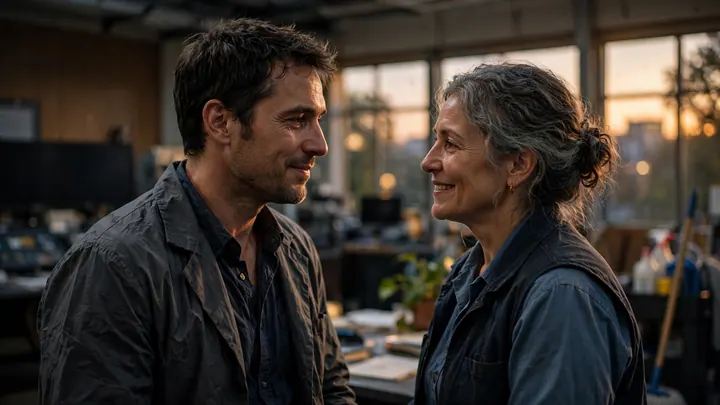
It didn’t take long. I found her in the building’s small, utilitarian breakroom, sipping a cup of tea, her silver hair still pulled back in its severe bun, her uniform immaculate despite the previous night’s drama. She looked up as I entered, her steel-gray eyes meeting mine without surprise. It was clear she had expected me.
“Dr. Henderson,” she said, her voice still carrying that quiet, measured tone. “I trust the probe is secure.”
“Yes, thanks to you, Ruth,” I replied, my voice filled with genuine gratitude. “But I… I need to understand. That badge… Apollo 11…” I trailed off, unsure how to ask the question that burned within me.
She gave a small, almost imperceptible nod. “I was… involved. Deeply involved. In the early days. Before the shuttle program, before the private sector took hold. I was part of the team that crunched the numbers, that plotted the impossible trajectories.” She gestured to the empty chair opposite her. “Sit, Dr. Henderson. It’s a long story.”
As I sat, she began to speak, her words painting a vivid picture of a bygone era. She spoke of the frantic energy of Mission Control, the sheer audacity of the Apollo program, the collaborative spirit that drove them to achieve the unimaginable. She had been a brilliant mathematician, a prodigy who found her calling in the complex dance of celestial mechanics. Her calculations had been instrumental in ensuring the success of missions that captured the world’s imagination.
“But,” she continued, her voice softening slightly, “after Apollo, things changed. Priorities shifted. The world moved on. My contributions, while significant, became footnotes in history books. And… there was a personal tragedy. My husband, a fellow engineer, was lost in an accident related to early shuttle testing. The risks… they became too much. I retreated.”
She explained that she had chosen a life away from the limelight, seeking anonymity and peace. The custodial work, while a far cry from her previous life, offered a sense of grounding, a tangible connection to the world. Yet, her mind, she confessed, never truly stopped calculating. The stars were in her blood.
“Last night,” she said, her gaze steady, “when I saw your equations, I saw the same hubris that nearly cost us so much in my time. The blind faith in one’s own brilliance, the overlooking of fundamental principles. The Kerr metric… it’s a beast if not handled with respect. I couldn’t stand by and watch you repeat history’s mistakes.”
My own ego felt paper-thin. Here was a woman who had literally helped put men on the moon, yet she found herself cleaning floors, her genius hidden in plain sight. It was a testament to her character, her resilience, and perhaps, a indictment of a system that often overlooked its most valuable assets.
“Why didn’t you come forward sooner?” I asked, the question hanging heavy in the air.
She smiled, a genuine, warm smile this time. “Because sometimes, Dr. Henderson, the universe provides its own epiphanies. You needed to be broken down to be rebuilt. You needed to see that true brilliance isn’t about ego, but about service. About ensuring the mission succeeds, no matter the cost to personal pride.”
She stood, picking up her tea cup. “My work here is done. The probe is safe. And perhaps,” she added, her eyes twinkling, “you’ve learned a valuable lesson about the people who keep the lights on, both literally and figuratively.”
As Ruth walked out of the breakroom, leaving me in the quiet contemplation of her story, I knew my life had irrevocably changed. The cosmos held infinite wonders, but the human spirit, in its quiet resilience and hidden depths, was the greatest mystery of all. The takeaway? True genius often wears a uniform, and sometimes, the most profound calculations are made not in equations, but in the quiet moments of human connection and quiet wisdom.
Share this story
Send it to someone who would enjoy it.
Keep reading
More stories
Second Chances
He Shredded My Boarding Pass While My Baby Died in My Arms — Then a Pilot Saw My Face and Froze
A desperate doctor and her sick infant are humiliated by a cruel airline supervisor — until a veteran pilot recognizes her and unleashes a fury no one expected.
11 min readFiction
Second Chances
A Biker Stood Guard Over a Crying Girl in a Grocery Aisle — Then the Truth Came Out
When a burly biker sees a little girl clinging to his leg in fear, he faces an angry father demanding she be returned. But the girl's plea reveals a dark secret that changes everything for both of them.
11 min readFiction
Second Chances
The Janitor Who Saved a Dying Child by Exposing a Top Surgeon's Deadly Secret
An autistic hospital orderly spots a rare eye marker that reveals a surgical cover-up. She risks everything to save a dying child and exposes a celebrated doctor's darkest lie.
9 min readFiction
Second Chances
Influencer Smashes Blind Violinist's Stradivarius — Then a Maestro Walks In and Changes Everything
Julian, a viral influencer, destroys an old blind man's violin on livestream. But the instrument wasn't just any violin — it was a 1714 Stradivarius worth millions. Now a furious maestro is about to turn Julian's world upside down.
13 min readFiction
Second Chances
He Fired the Old Laborer in the Rain — Then the Real Owner Stepped Out of a Mercedes
A cocky site manager humiliates a veteran laborer in front of everyone. But the old man's past holds a secret that will shatter Derek's world in one thunderous moment.
12 min readFiction
Second Chances
Billionaire Humiliates Veteran at Gala, Then Discovers He Owns the Bank — What Happens Next Stuns Everyone
A wealthy banker spits on a homeless veteran at a charity gala, not knowing the veteran is the secret owner of the bank. The shocking reveal leaves everyone speechless and changes lives forever.
7 min readFiction