Forum StoriesSecond ChancesFiction15 min readPart 3 of 3
The Billionaire's Secret: How A Mysterious Janitor Saved The World From Astrophysics Disaster — Part 3 of 3
By WixForum KitchenPublished
The Custodian's Wisdom
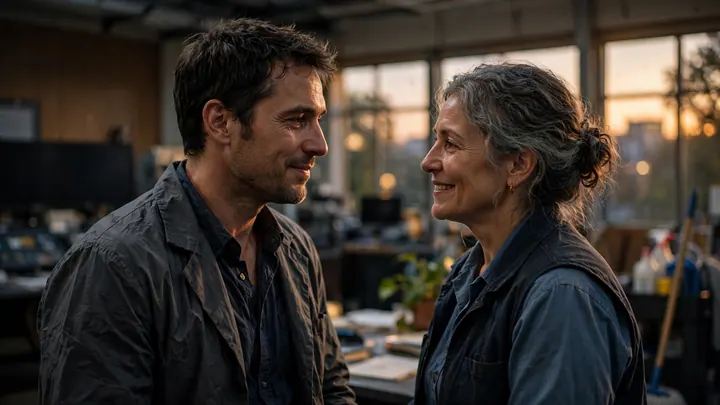
Ruth’s departure left a profound silence in the small breakroom, a silence that echoed with the weight of her story. The scent of her tea lingered, a subtle reminder of the extraordinary encounter. I sat there for a long time, the gleaming marble floor of the penthouse gallery seeming a distant memory, replaced by the stark reality of a woman who had touched the face of the moon and now navigated the mundane corridors of a luxury building.
Her words, “You needed to be broken down to be rebuilt,” resonated deeply. My arrogance had been a shield, protecting a fragile ego, but it had also been a prison, blinding me to the truths that lay beyond my own perceived brilliance. Ruth, in her quiet dignity, had shattered that prison.
I finally stood, a sense of purpose solidifying within me. My original mission was complete; the probe was safe. But a new, more personal mission had begun: to ensure that Ruth’s incredible story, her vital contributions, were not lost to the footnotes of history. It felt like a betrayal to let her fade back into anonymity after she had saved not just a mission, but perhaps, in a way, my own professional soul.
Returning to my apartment, the opulent surroundings felt less like a triumph and more like a gilded cage. I spent the next few days in a whirlwind of activity, not of scientific equations, but of phone calls and emails. I reached out to contacts within NASA, to historians of the space program, carefully broaching the subject of a brilliant, yet largely uncredited, mathematician from the Apollo era.
The initial responses were polite but dismissive. Names and dates were checked, archives scoured, but nothing concrete emerged about a Ruth involved in the core calculations of Apollo 11. It seemed her contribution, if it existed as she described, had been completely buried, perhaps deliberately obscured.
Frustrated but undeterred, I decided on a different approach. I needed to speak with Ruth again, to understand the nuances, the potential reasons for her obscurity. I found her later that week, meticulously cleaning the penthouse’s grand lobby. She greeted me with the same calm demeanor, the same observant eyes.
“Ruth,” I began, “I’ve been trying to find any official record of your work during Apollo. It seems… it’s not easily accessible.”
She offered a wry smile. “History is often written by the loudest voices, Dr. Henderson. Sometimes, the most critical work is done quietly, behind the scenes. My husband… he was a visionary, but also a risk-taker. His accident… it cast a long shadow. Some feared association with his controversial theories, even posthumously. My own work became… inconvenient.”
She explained that her focus had been on highly theoretical aspects of trajectory and gravitational dynamics, pushing boundaries that were considered too abstract, too risky by the more conservative elements within the agency at the time. While her calculations were sound, her husband’s later, more radical pursuits had led to her work being sidelined, deemed too close to his ‘unproven’ ideas.
“It wasn’t just about the math,” she confessed, her voice barely above a whisper. “It was about the politics, the egos. After John died, I simply… withdrew. The quiet life of a custodian seemed a small price to pay for peace, and for keeping his memory untarnished by association with any perceived failures.”
Her story was a heartbreaking illustration of how brilliance can be silenced, how personal tragedy and institutional inertia can conspire to erase significant contributions. It wasn’t a tale of overt betrayal, but a subtler, more insidious form of marginalization.
“But your knowledge,” I insisted, “it’s invaluable. Last night proved that. You saved a multi-billion dollar mission. You understand physics on a level few ever will.”
Ruth simply shrugged, a gesture that spoke volumes of acceptance. “My time for grand calculations has passed, Dr. Henderson. My contribution now is to ensure that those who follow do so with both brilliance and humility. Perhaps your experience last night is my way of contributing now – a reminder, delivered through you, to the scientific community.”
I realized then that Ruth wasn’t seeking recognition. Her satisfaction came from the act of solving, of ensuring the right outcome, regardless of who received the accolades. Her final act of intervention was not about personal glory, but about upholding the integrity of science itself.
“Thank you, Ruth,” I said sincerely. “For everything. Not just for saving the probe, but for… for teaching me.”
She met my gaze, her steel-gray eyes holding a deep, quiet wisdom. “The universe is full of mysteries, Dr. Henderson. Some are written in the stars, and some are found in the quietest corners of our world. Never stop looking for both.”
As I left the lobby, the sun streaming through the vast windows, I carried with me not just the relief of a saved mission, but the profound lesson of Ruth’s legacy. True greatness often operates in silence, its impact far-reaching even when unrecognized. The greatest discoveries, I understood now, were not always about reaching the stars, but about understanding the universe within ourselves and the quiet heroes who shape our world.
Share this story
Send it to someone who would enjoy it.
Keep reading
More stories
Second Chances
A Biker Stood Guard Over a Crying Girl in a Grocery Aisle — Then the Truth Came Out
When a burly biker sees a little girl clinging to his leg in fear, he faces an angry father demanding she be returned. But the girl's plea reveals a dark secret that changes everything for both of them.
11 min readFiction
Second Chances
The Janitor Who Saved a Dying Child by Exposing a Top Surgeon's Deadly Secret
An autistic hospital orderly spots a rare eye marker that reveals a surgical cover-up. She risks everything to save a dying child and exposes a celebrated doctor's darkest lie.
9 min readFiction
Second Chances
Influencer Smashes Blind Violinist's Stradivarius — Then a Maestro Walks In and Changes Everything
Julian, a viral influencer, destroys an old blind man's violin on livestream. But the instrument wasn't just any violin — it was a 1714 Stradivarius worth millions. Now a furious maestro is about to turn Julian's world upside down.
13 min readFiction
Second Chances
He Fired the Old Laborer in the Rain — Then the Real Owner Stepped Out of a Mercedes
A cocky site manager humiliates a veteran laborer in front of everyone. But the old man's past holds a secret that will shatter Derek's world in one thunderous moment.
12 min readFiction
Second Chances
Billionaire Humiliates Veteran at Gala, Then Discovers He Owns the Bank — What Happens Next Stuns Everyone
A wealthy banker spits on a homeless veteran at a charity gala, not knowing the veteran is the secret owner of the bank. The shocking reveal leaves everyone speechless and changes lives forever.
7 min readFiction
Second Chances
My Boss's Wife Vanished in an Explosion — Years Later I Found His Baby Crying at Midnight
A quiet kitchen maid calms the baby no one else can, until a fallen sleeve reveals a tattoo that shatters the Varric family's darkest secret.
8 min readFiction